Shao Fan: The Nature of Things
Perhaps the future is the reflection of the past. When one looks back deeply enough,
one begins to see what lies ahead.
— Shao Fan
1
When we encounter Shao Fan’s “chair” again in the present moment, it stands in silence—neither a sculpture in the traditional sense nor a piece of furniture in the conventional sense. The “mystery of its species” remains unresolved. The contradictions it carries continue to radiate their particular force: it is both the full realization of the mortise-and-tenon system and a site of dialogue with geometric principles; both a deduction of primordial functionality and an object transformed beyond function by intuitive force. Within such relations, seemingly contradictory elements regulate one another into a single form. It faces us, addressing our bodies with a call that is at once intimate and unfamiliar.
As witnesses, observers, and participants in empathy, we find ourselves drawn into a process in which meaning is co-generated. In this brief encounter, our sense of space and time trembles. We stand before an object bearing traces of construction across time, and seem to experience time itself as something reorganized.
2
Behind the Ming-style chair lies the precise mechanism of mortise and tenon. The protruding tenon enters the recessed mortise; surfaces interlock through friction and pressure, forming a self-stabilizing structure. The expansion and contraction of the wood are calculated into the design, allowing the structure to remain stable across the seasons. Concave and convex, yin and yang, are not oppositional terms, but tensions formed through contact. By responding to the inherent properties of materials, order maintains itself in the very act of generation.
If Yuk Hui’s notion of cosmotechnics suggests that technology is not a neutral tool but a mode of practice embedded within a specific cosmic order, then mortise and tenon may be understood as a technical system that embodies a worldview—an unfolding of cosmological principles within the object itself. The phrase from the Kaogong Ji—“Heaven has its timing, Earth has its qi, materials have their beauty, and craftsmanship has its skill”—resonates precisely with such a generative cosmotechnical archetype, in which structure emerges from the mutual modulation of Heaven, Earth, and human agency.
At the same time, we must imagine that there is no singular technological logic in the human world. There are multiple cosmotechnics. Different cultures, grounded in their own dynamics, offer distinct responses to what constitutes the cosmos, what defines order, and how cosmic structure and moral orientation may be unified.
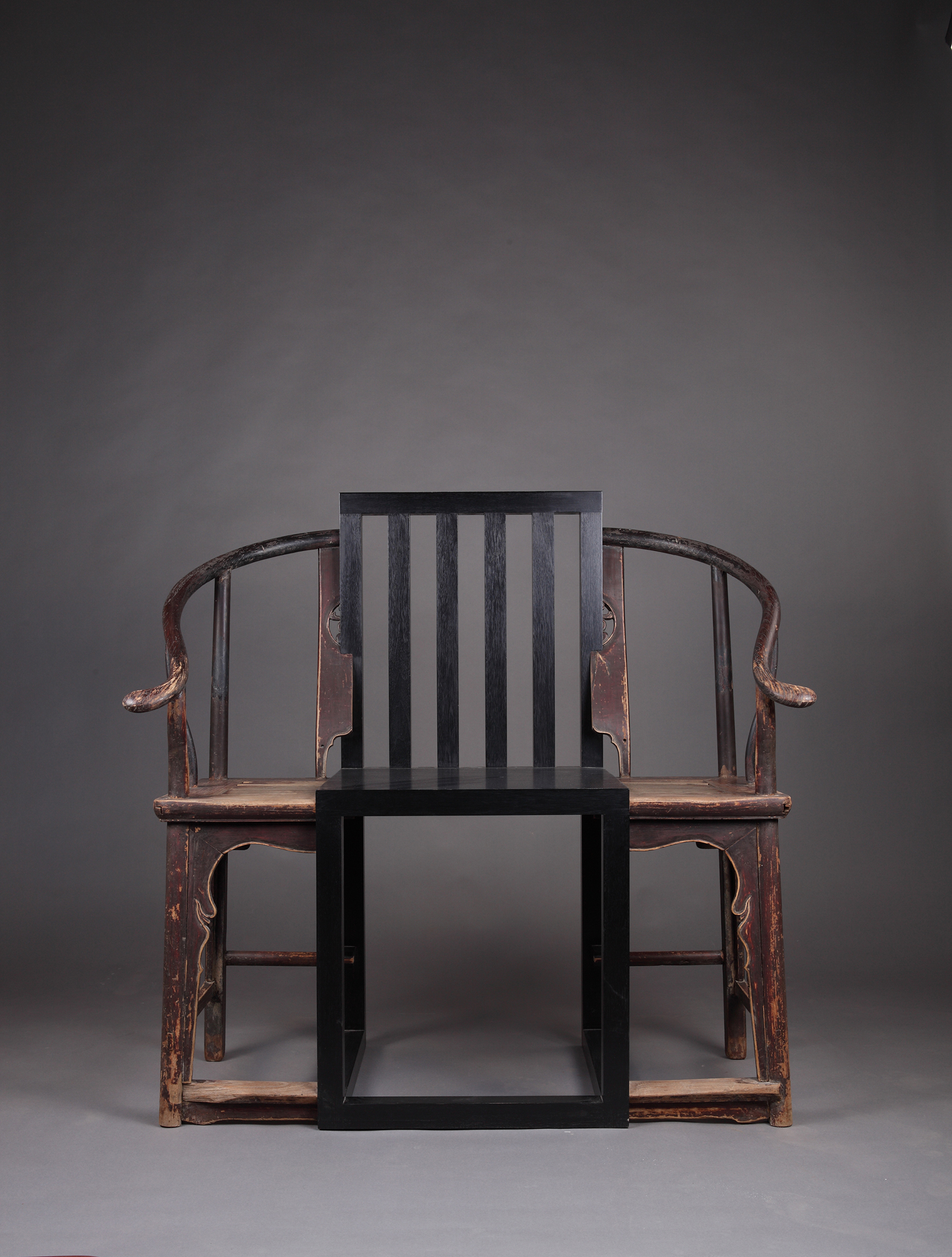
Shao Fan,Work No. 1, 1995,1995,elm wood, catalpa wood,107 × 108 × 52 cm. Courtesy of the artist and Vitamin Creative Space.
When a geometric structure—an expression of cosmic order extending from ancient Greek thought to modernity, which we may tentatively describe as a geometric, model-based cosmotechnical archetype—is embedded within the framework of mortise-and-tenon as a generative cosmotechnics, different constructive logics and cosmological visions overlap and permeate in the same object. They activate one another and come into renewed vitality. Intricate relations are reorganized at points of contact; differences are not erased, but acquire new configurations through interlocking. In the “between” where these two cosmotechnical archetypes meet, what was once a closed object framework unfolds into a flowing trajectory.
3
In a series of three-dimensional works produced after the turn of the millennium, in which geometric structures are no longer embedded, Shao Fan pushes the generative logic of mortise-and-tenon technique toward an extreme of “usefulness of the useless.” The mortise-and-tenon joints are not established solely for functional efficiency; some exist purely to articulate the proportional flow of the overall line and the organic presence of curved surfaces. The form no longer positions itself in contrast to geometric models, but instead emerges through the sustained internal modulation of curvature and tension.
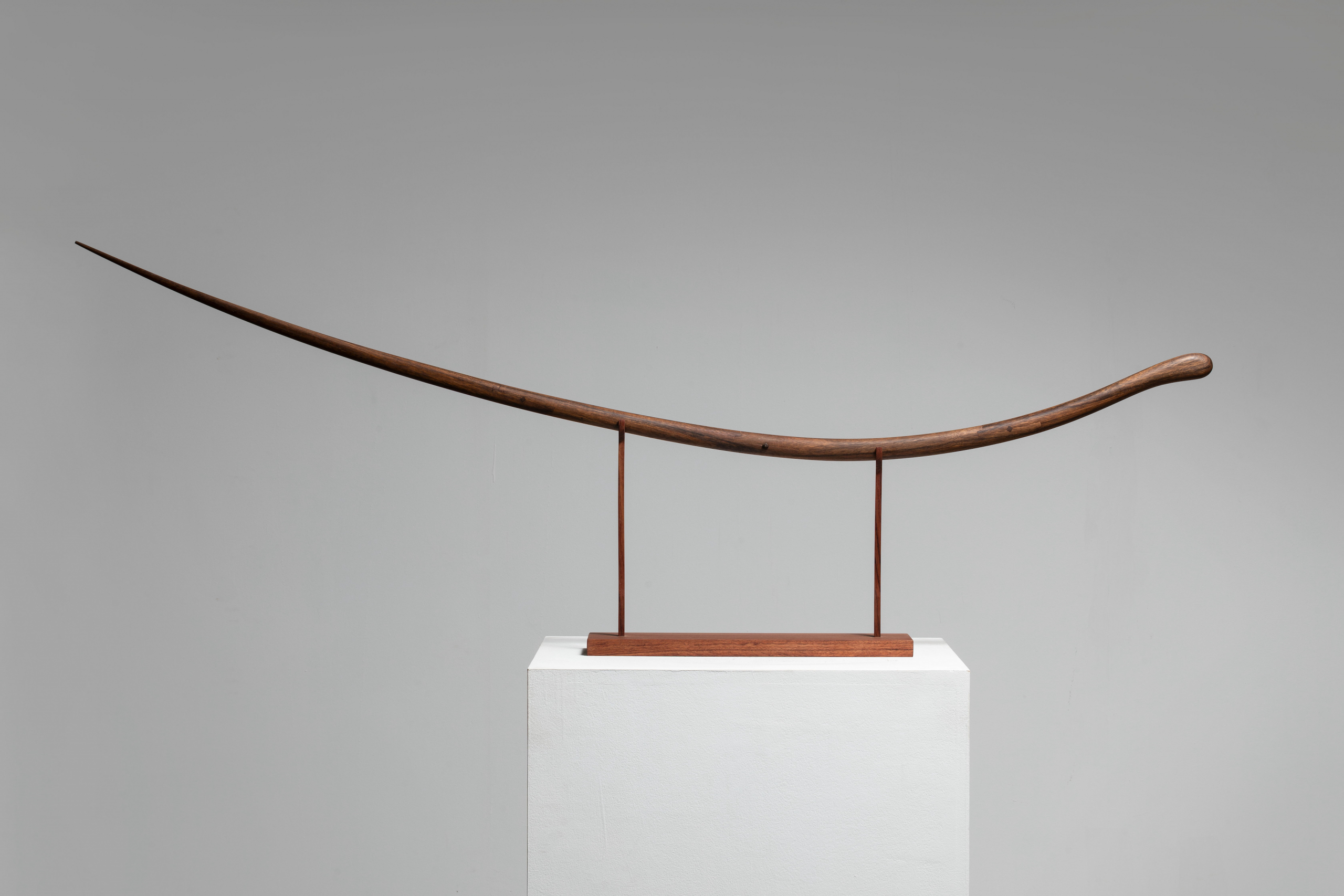 Shao Fan, Ming-Style Eyelash, 2007, walnut wood, 57 × 153 × 12 cm,Φ 6 cm. Courtesy of the artist and Vitamin Creative Space.
This exploration of generative mechanisms naturally extends, for Shao Fan, to the boundary between three-dimensional and two-dimensional realms. The two-dimensional works are no longer representations of three-dimensional structures, but manifestations of the generative process itself. Mortise-and-tenon logic transforms into relational boundaries between forms; positive and negative shapes co-constitute the totality of the composition through transition. It is as though things gradually unfold from an undifferentiated ground—silk or paper—emerging from a state of indistinction toward the birth of a natural order.
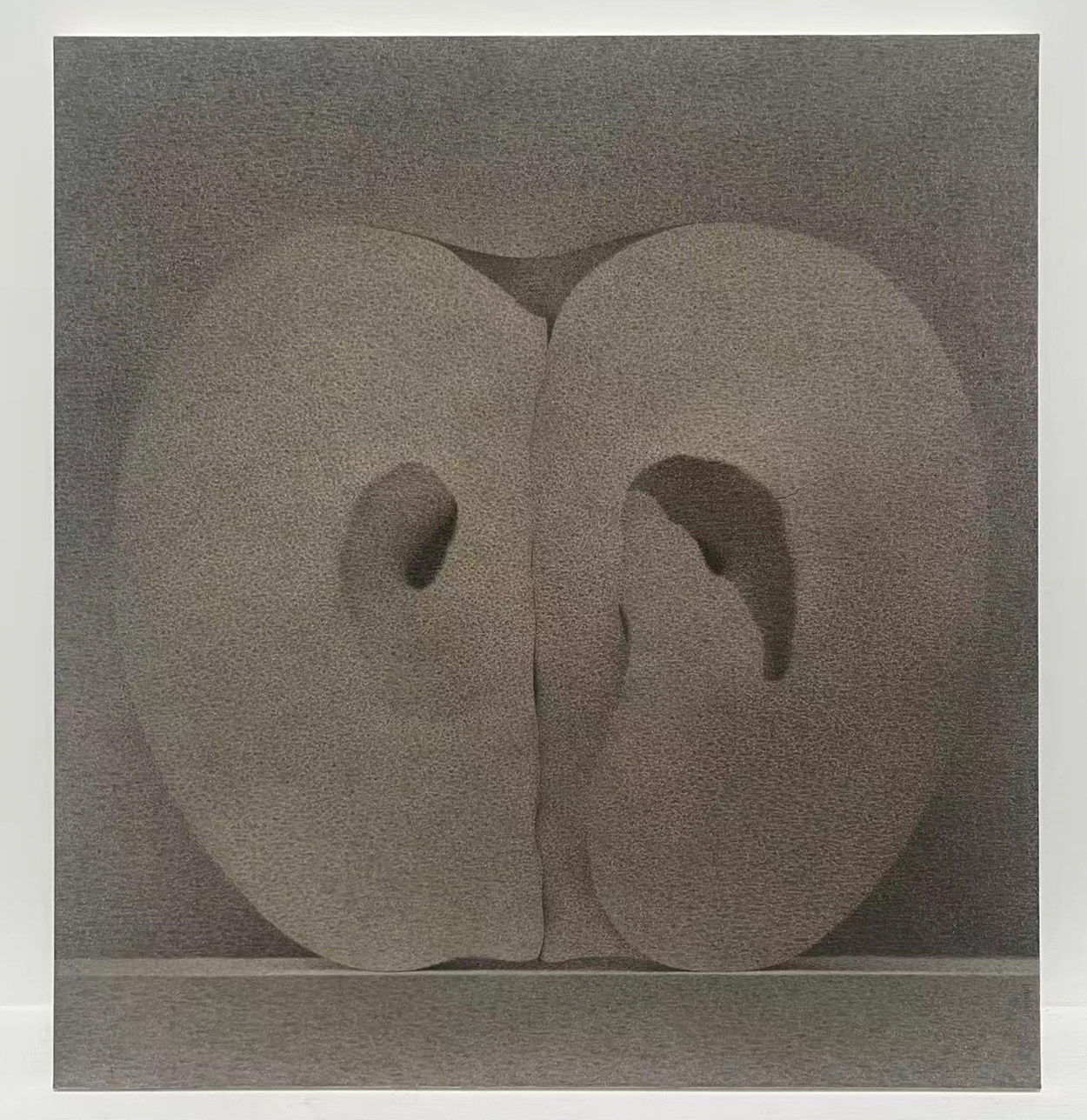
Shao Fan, Fruit 1525, 2025, Ink on rice paper, 80 × 75 cm. Courtesy of the artist and Vitamin Creative Space.
4
Under contemporary technological conditions, these ancient cosmotechnical principles enter into a subtle resonance with digital technology. Digital logic, grounded in the binary units of 0 and 1, embodies a model-based and calculable structure that may align more closely with the model-oriented cosmotechnical tradition of Greek formalism. Yet as computational structures increasingly manifest as networked topologies and appear to move toward “generative algorithms,” we are prompted to reconsider the generative cosmotechnics embodied in mortise-and-tenon interlocking and in the modulation of brushstroke in Chinese painting. This generative archetype establishes a dynamic equilibrium through continuous, non-disruptive tensions of yin-yang interpenetration.
Both systems begin with difference. Yet they orient that difference differently: the former emphasizes switching and separation, transforming the world into calculable units; the latter emphasizes complementarity and generation, understanding the world as a dynamically unfolding field of relations. Thus the question is not one of tradition versus contemporaneity, nor of past versus present, nor of opposing technologies. Rather, it concerns how the world is to be understood and perceived today—and whether structure still allows generation: is the world composed of divisible units, or sustained through mutually generative relations? Will temporal divergences lead toward increasing fragmentation and discreteness, or toward renewed formation?
When Shao Fan turns backward in order to illuminate the future, we come to recognize that past and future enter into a dynamic polarity—forming a reciprocal, generative relation across time and space. In this sense, such retrospection is not a return to historical forms, but a reflection upon, and renewed practice of, generative principles. When structure persists within relations, and difference unfolds within continuity, the future ceases to be merely the extension of a model and becomes instead the possibility of generation. The “ahead” may not lie in the endless acceleration of technology, but in how we re-engage the practice of generation and structure—at the moment when the nature of things becomes an insight into our relation with the world.
(Hu Fang)